

Use a live rebirth tracker and planner to decide when to rebirth and to measure progress: this is the fastest way to optimize long-term gains. Open a tracker or download a companion app before your next session, log your current credits, droid counts, and chip totals, then let the outputs guide timing. Players who track consistently get better rebirth timing and more predictable progression than players who guess.
TL;DR:
- Consistent tracking of credits, droid counts, and chips helps timing rebirths more accurately than guessing, especially when assessing thresholds for standard and super rebirths.
- Rebirth requirements depend on specific thresholds for droids, credits, and sometimes level; comparing these numbers against current progress prevents premature or delayed rebirths.
- Using live tools like companion apps or spreadsheets minimizes estimation errors and allows calibration after game updates, improving prediction accuracy over time.
- Base layout and placement strategies significantly influence passive income, and measuring their impact through a tracker guides effective optimization decisions.
- Saving chips for higher-rarity droids and forecasting future resource needs prevents resource stalls and maximizes progress toward rebirth milestones.
Table of Contents
- What Rebirths Are and How They Change Progression
- Rebirth Requirements and Level Thresholds
- Trackers and Tools: How to Monitor Live Progress and Plan Rebirths
- Base Layout and Income Optimization
- Upgrade Chips, Bottlenecks, and Resource Prioritization
- Rebirth Planning Playbook: When to Rebirth and How to Set Realistic Targets
- Why a Tracker-First Approach Beats Guesswork
- Droidex Companion: Download and Quick Start
- Sources
- FAQ
What Rebirths Are and How They Change Progression
A rebirth resets specific in-game variables (droids, credits, and certain unlocks) in exchange for permanent bonuses that accelerate the next cycle. Super rebirths raise the stakes further, typically demanding higher droid counts and credit thresholds while granting stronger permanent multipliers, according to the Rebirths wiki page. What persists through a rebirth and what resets varies by path, which is why tracking matters: you need to know exactly which numbers restart and which carry forward before you commit.
Droid counts and credits are the variables that change most visibly after a rebirth. Both typically drop to a baseline, while permanent upgrade tracks and unlocked content tend to stay. The Fortnite Wiki's Droid Tycoon entry describes the base structure, workshop mechanics, and shipyard missions that generate credits and experience—all of which reset to different degrees depending on the rebirth path chosen.
Timing matters because rebirthing too early wastes progress you have already banked, while waiting too long stalls your account below its potential growth rate. A tracker converts this timing question into a number: how many more minutes or sessions until your credits and droid count clear the next threshold. Without that number, players tend to rebirth on instinct, either too soon or well past the point of diminishing returns. Collection goals compound the problem, since some droids only become available after specific rebirth milestones, so a tracker that flags those unlocks keeps long-term collection targets visible instead of buried under short-term grinding decisions.

Rebirth Requirements and Level Thresholds
Requirement paths vary, but most share the same three components: a droid count, a credit total, and sometimes a level threshold tied to base progress. The Rebirths wiki documents these paths in detail, and checking your current numbers against them is the first step before opening any planner.
Reading a requirement table is straightforward once you know what each column measures. The droid count column tells you how many droids you need active or built, the credit column sets the banked total required, and the path column distinguishes standard rebirths from super rebirths, which generally demand higher thresholds across both categories.
| Requirement type | What it measures | When it typically applies |
|---|---|---|
| Droid count | Active or built droids needed | Standard and super rebirth paths |
| Credit total | Banked currency required | All rebirth paths |
| Level threshold | Base or account level gate | Paths tied to progression milestones |
| Path variant | Standard vs. super rebirth | Determined by chosen progression route |
To check your in-game progress against this table, compare your current droid count and credit balance directly to the path you are targeting. If you are short on droids but have surplus credits, your next session should prioritize droid acquisition over credit farming, and vice versa. Super rebirth paths apply once you have cleared the standard rebirth cycle at least once, since they build on the permanent bonuses that standard rebirths unlock.
Examples of when each path applies depend on account stage. Early accounts almost always follow the standard path, since super rebirth thresholds are out of reach until droid counts and credit totals climb well past the first few cycles. Mid and late-game accounts shift toward super rebirth paths as permanent multipliers from earlier cycles make the higher thresholds achievable in a reasonable number of sessions.
Trackers and Tools: How to Monitor Live Progress and Plan Rebirths
Three tool types cover most tracking needs: browser trackers, companion apps with local screen recognition, and manual spreadsheets. Browser trackers work without sign-up and save progress locally, which suits players who want a quick reference without installing software. Spreadsheets give full control over calculations but require manual entry after every session, which introduces lag and error. Companion apps with local screen recognition, such as Droidex Companion, read stats directly from the game window, removing the manual entry step entirely.
Setting up any tracker follows the same core checklist:
- Record your current credits, droid count, and upgrade chip total at the start of a session.
- Log your pickaxe level and any active base multipliers, since these affect income rate.
- Input these figures into your chosen tracker or planner.
- Read the time-to-target output, which estimates sessions or minutes until you clear your next rebirth threshold.
- Check the chip deficit figure if your tracker provides one, since chip shortages are a common late-game bottleneck.
Interpreting these outputs takes a few sessions to calibrate. Time-to-target numbers assume a steady income rate, so a session with unusually high or low credit gains will skew the estimate until the tracker averages in more data points. A chip deficit output flags how many additional chips you need before your next planned upgrade, which matters more as droid rarity increases.
Testing accuracy means comparing your tracker's predicted totals against your actual in-game numbers after a session or two. If the gap is small, the tracker is calibrated. If it is large, check whether a recent patch has changed base income or cost values, since rebalances can shift the math your tracker relies on. The Star Wars Droid Tycoon map page lists a version history showing updates as recent as August 2, 2026 at version 113, which is a useful reference point for confirming whether your tracker reflects the current build.

A practical walk-through: say your tracker shows a partial credit bank against the required total, with droid count already cleared. At your current income rate, the tracker estimates a short time to close the gap. That number tells you whether to keep playing this session or log off and return once you have a full block of time to clear the threshold in one sitting.
Pro Tip: Recalibrate your tracker's income estimate every time a patch changes base costs or droid stats, since stale multipliers produce misleading time-to-target numbers.
Base Layout and Income Optimization
Base layout affects passive income more than almost any other single decision, because placement determines how efficiently missions, shop interactions, and droid output combine. The IGN tips guide for Droid Tycoon notes that upgrading the pickaxe and using the Jawa Conveyor Shop effectively both raise the credit and experience rate per action, which compounds heavily over a full session.
Layout patterns that consistently perform well share a few traits:
- Droids placed near shop interaction points reduce idle travel time between actions.
- Mission entry points positioned close to the base core shorten the loop between missions and income collection.
- Upgrade stations grouped together let you batch chip spending instead of crossing the map repeatedly.
- Pickaxe upgrade priority early in a session raises the baseline rate for every action that follows.
Measuring the effect of a layout change is simple with a tracker running: log your credits-per-minute rate before the change, make the adjustment, then log the rate again after a comparable play window. A tracker that stores both sessions side by side turns a layout tweak from a guess into a measured decision, and the base income planner on Droidex's tools page is built specifically to convert layout and droid choices into expected income figures before you commit in-game.
Upgrade Chips, Bottlenecks, and Resource Prioritization
Upgrade chips become the limiting resource late in most accounts, since higher-rarity droids demand disproportionately more chips than lower-tier ones. This nonlinear scaling means a player who spends chips freely early can find themselves stalled several rebirth levels later, unable to reach the next droid tier despite having ample credits.
A few heuristics keep chip spending aligned with rebirth goals:
- Save chips for high-rarity droids once your account passes the early game, since their chip cost rises faster than their power gain justifies spending early.
- Spend chips on droids that directly unlock new mission tiers, since those unlocks often raise your income ceiling more than a flat power boost.
- Track chip accumulation rate alongside credits, since a credit-rich, chip-poor account is a common late-game trap.
- Forecast chip requirements for your next two planned rebirth levels, not just the immediate one, to avoid a mid-cycle stall.
Tracking chip accumulation works the same way as tracking credits: log your total at session start, log it again at session end, and let your tracker compute the rate with some advanced skin trading tactics to inform value tracking. Forecasting future requirements means checking the chip cost of droids tied to your next rebirth path before you start spending, which the droid catalog on Droidex lists by rarity and stat tier.
Pro Tip: Check chip costs for your next two rebirth targets before spending on your current one, since a droid that looks affordable now may block a more valuable unlock later.
Rebirth Planning Playbook: When to Rebirth and How to Set Realistic Targets
Deciding whether to rebirth now or grind another session comes down to a short checklist:
- Confirm your droid count and credit total both clear the requirement for your target path.
- Check your chip deficit; if it is significant, consider one more farming session before committing.
- Verify no pending unlock or collection item requires one more grinding cycle before the reset.
- Compare your time-to-target estimate against the time you actually have available this session.
Setting targets inside your tracker means entering both a time-to-rebirth estimate and a resource target (credits, droids, and chips) for your chosen path, then letting the tracker flag when you cross each threshold.
Two sample plans illustrate how this looks in practice. A fast progression plan targets the minimum requirement for each rebirth path, cycling through rebirths quickly to stack permanent bonuses even if some droids or chips go unused. A completion or collection plan instead holds off on rebirthing until every available droid and collection item for the current cycle is secured, trading rebirth speed for a fuller roster before each reset. Both plans use the same tracker inputs, they just set different thresholds as the trigger point.
Why a Tracker-First Approach Beats Guesswork
Players who log credits, droid counts, and chip totals every session tend to reach rebirth thresholds on a predictable cadence rather than by chance. A tracker turns a vague sense of progress into a specific countdown, which removes the guesswork that leads most players to either rebirth too early or sit idle past the point of benefit.
The clearest gain shows up in rebirth cadence: an account that tracks time-to-target consistently tends to close each rebirth cycle faster than one relying on memory and instinct, simply because every session starts with a clear target instead of a rough estimate.
— Daniel
Droidex Companion: Download and Quick Start
Droidex Companion reads your stats directly from the game window through local screen recognition, which removes the manual logging step described throughout this guide. It maps directly onto the tracker inputs above: credits, droid counts, chip totals, and pickaxe level feed into a live rebirth planner that forecasts time-to-target and chip deficit automatically.
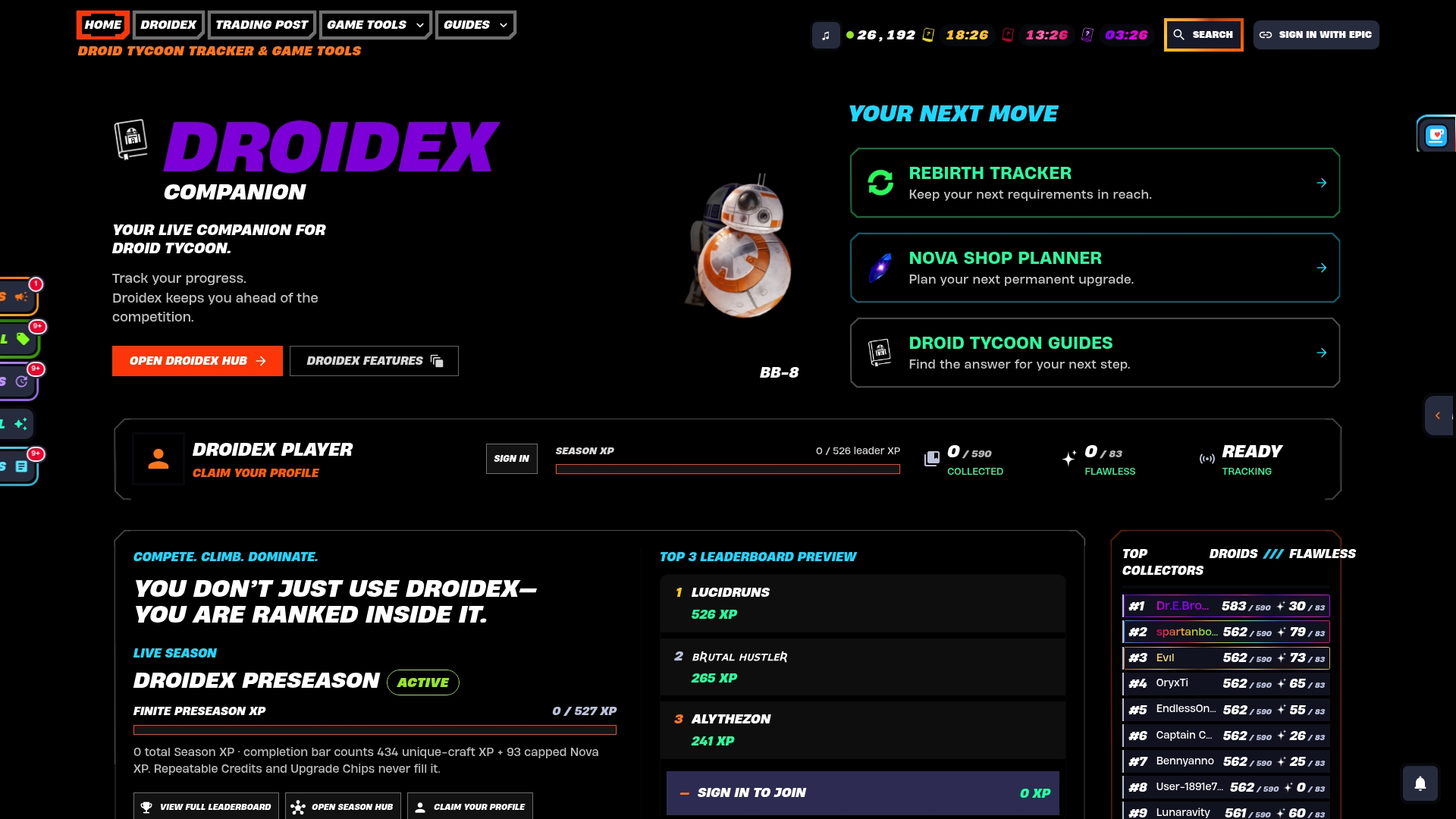
- Live stat tracking reads your credits, droids, and chips without manual entry.
- The rebirth planner forecasts time-to-target using session data.
- Customizable overlays keep key numbers visible during play.
- A leaderboard system lets users compare cadence and progress against others.
Download Droidex Companion from its main landing page, install it, and open it alongside Droid Tycoon to start a tracked session. The dedicated rebirth cycles page walks through setting your first target once the app is reading your live stats. Core features remain free to use.
Sources
Check the Rebirths wiki for exact requirement numbers, the map's version history for update cadence, and Droidex's tools page for live trackers and planners. Recalibrate after every patch.
FAQ
Does Droid Tycoon Save Your Progress?
Droid Tycoon saves your account progress, including droids, credits, and rebirth history, tied to your player profile rather than to a single session. A live tracker such as Droidex Companion supplements this by logging session-level detail the game itself does not surface, like time-to-target for your next rebirth.
What Is the Highest Level in Droid Tycoon?
Droid Tycoon does not publish a single fixed maximum level; progression continues through standard and super rebirth cycles, each raising permanent bonuses further. The Rebirths wiki documents these paths, and checking a tracker against current requirements is the most reliable way to see where your account stands relative to the highest known thresholds.
Will Droid Tycoon Stay Forever?
Droid Tycoon's availability is not publicly listed as permanent or time-limited, and the map's active update history, including a version 113 update recorded on August 2, 2026 according to the map page, indicates ongoing development rather than a scheduled removal.
Which Droids in Droid Tycoon Have the Highest Pay?
Pay scales with droid rarity and tier, with higher-rarity droids generally producing more credits per action but also demanding more upgrade chips to reach that output. Checking a droid catalog by rarity and stat tier is the most direct way to compare specific droid pay rates before committing chips to an upgrade.