

Leaderboard etiquette means submitting only verified, honest attempts and treating every competitor with respect, in public comments and in disputes alike. The single action to take right now: never post a score you cannot back up with a match ID, timestamp, or recording, and keep every public exchange about rankings free of personal attacks. Everything else in ranked competition follows from that one habit.
TL;DR:
- Only submit verified, reproducible attempts with clear proof, and disclose all session details when posting suspicious scores.
- Use a consistent, transparent process for handling ties and ranking disputes, with predefined rules and proper evidence requirements.
- Report suspected manipulation privately with comprehensive evidence, expecting a fair review process that includes giving involved players a chance to respond.
- Enforce community etiquette by keeping chat brief, respectful, and avoiding public personal accusations to maintain a healthy leaderboard environment.
- Well-designed leaderboards with clear rules and moderation create community trust, reducing disputes, boosting engagement, and discouraging cheating.
Table of Contents
- Core Principles Behind Leaderboard Etiquette
- Rules for Eligible vs. Ineligible Leaderboard Entries
- How Anti-Cheat Detection Actually Works
- Reporting Suspected Manipulation and Getting a Fair Review
- Etiquette for Chat, Trash Talk, and Public Disputes
- Best Practices for Organizers Running a Leaderboard
- What Fair Moderator Due Process Looks Like
- Privacy and Data Protection on Public Leaderboards
- Handling Ties and Ranking Disputes Fairly
- Communicating Leaderboard Updates Without Causing Confusion
- Behaving Well in Public Leaderboard Chats and Comments
- Why Leaderboard Etiquette Shapes Community Health
- A Note on Why This Matters
- Track Your Progress Without the Guesswork
- Sources
- FAQ
Core Principles Behind Leaderboard Etiquette
Four values separate a healthy leaderboard from a toxic one. Integrity comes first: you submit only attempts you can prove happened the way you say they did. Respect means disagreements about a ranking stay about the ranking, never about the person. Transparency means you disclose the conditions of a run when you post it, not just the number. Accountability means accepting that a moderator might review your entry, and treating that review as normal rather than an insult.
- Submit only legitimate, reproducible attempts, not lucky glitches or exploits
- Avoid personal attacks, mockery, or public shaming of other players
- Disclose session details (mode, settings, opponent) when a score looks unusual
- Expect moderator review and respond to it without hostility
Pro Tip: Screenshot or record your session the moment you hit a milestone score. Reconstructing proof after a dispute starts is far harder than capturing it in real time.
These four principles do the heavy lifting when a rule doesn't cover a gray-area case. Ask which value your action honors before you post.
Rules for Eligible vs. Ineligible Leaderboard Entries
Most leaderboard disputes come down to entries that never should have qualified in the first place. Eligible submissions usually share a few traits: they follow the required run corridor or timing window, use the game's standard settings, and come from a completed, unedited session. Ineligible entries typically involve practice runs mislabeled as attempts, calibration sessions, or scores that show obvious signs of manipulation, like impossible reaction times or repeated matches against the same low-ranked opponent.
Run this checklist before you submit anything:
- Confirm the run matches the required mode, corridor, or timing rules exactly
- Verify the session was not a practice, warmup, or calibration attempt
- Check that no exploit, glitch, or unpatched bug contributed to the result
- Keep raw footage or logs available in case a moderator asks for verification
- Disclose anything unusual about the session in your submission notes
Borderline cases deserve caution over confidence. A score achieved right after a patch, before the community understands its effects, should probably wait a day before submission. A run against a friend who agreed to play passively sits closer to boosting than competition, even without malice. When in doubt, hold the submission and ask a moderator first. That single question prevents most disputes before they start.
How Anti-Cheat Detection Actually Works
Detection systems flag patterns, not proof. Statistical flags look for abnormal streaks, unusually narrow opponent diversity, or matches concentrated in short bursts that don't match normal play patterns. Technical flags separate client-side-only submissions, where the score comes from the player's own device with no outside check, from server-validated logs, where the game's servers independently confirm the events that produced the result.
- Statistical flags: repeated matches against the same accounts, streaks outside normal variance
- Technical flags: scores submitted without a matching server-side event log
- Behavioral flags: sudden performance jumps with no corresponding change in play style
Here's the part players often miss: automated flags are leads, not verdicts. Detection systems should treat flags as leads for investigation, since false positives are common, and manual verification of logs, session IDs, and video remains standard practice. A false positive that results in a permanent ban costs a legitimate player their standing and costs the moderator team its credibility with the whole community.
Good leaderboard design reduces the need for aggressive detection in the first place. Placement matches, diminishing returns on repeated opponents, and sensible rating adjustments make boosting and farming both less profitable and easier to spot. A well-tuned system catches manipulation through its structure before an algorithm ever needs to flag anything.
Reporting Suspected Manipulation and Getting a Fair Review
A weak report gets ignored. A strong one gets investigated. Before you report anything, collect match IDs, timestamps, video footage if you have it, and any log data the platform makes available. Vague accusations without evidence waste moderator time and rarely lead anywhere useful.
- Gather match IDs, timestamps, and video or log evidence before submitting anything
- File the report through the platform's official channel, not a public callout
- Expect acknowledgment first, investigation second, and a decision only after both
- If a provisional action is taken, expect a path to appeal with new evidence
- Wait for public resolution rather than pressuring moderators for a faster answer
A visible, time-bound review process paired with a right to respond is what keeps accused players from feeling railroaded and keeps the wider community confident the system is fair. Tools built for verifying Droid Tycoon data can make this step easier by giving you a documented record instead of a memory of what happened.
Pro Tip: Report privately first. A public accusation before moderators respond almost always makes a dispute harder to resolve fairly, for you and for the accused player.
Etiquette for Chat, Trash Talk, and Public Disputes
Trash talk has a place in competitive gaming. Insults don't. Keep exchanges short, skip the personal attacks, and resist the urge to escalate once someone else does. A win doesn't need commentary about the loser's skill to mean something.
- Keep competitive banter brief and skip anything personal
- Credit your opponent when a match was genuinely close or well played
- Move rank disputes to private messages or moderator channels, not public threads
- Step away from a thread before responding when you're angry
Celebrating a new personal best is fine. Celebrating it by mocking whoever you passed on the board isn't. When a dispute starts building momentum in public comments, that's the moment to move it private, not the moment to double down. Public pile-ons rarely produce a fair outcome. They just produce a louder one.
Best Practices for Organizers Running a Leaderboard
Trust on a leaderboard is built through design choices, not good intentions. Organizers who publish their scoring rules and separate leaderboards into clear categories give players fewer reasons to argue about what should count. Transparent, auto-updating standings with clearly published placement requirements measurably reduce complaints about opaque judging.
- Publish scoring rules and maintain separate categories for different play modes
- Require placement matches before a new entrant's rating stabilizes
- Set rate limits on submissions and tune rating adjustments to reduce volatility
- Archive past seasons and announce resets with clear advance notice
- Keep a written record of every moderation action for future reference
| Organizer Practice | Primary Benefit |
|---|---|
| Published scoring rules | Fewer disputes over what counts |
| Placement matches | Reduces early rating volatility |
| Rate limits on submissions | Slows farming and mass-boosting |
| Season archives | Preserves history through resets |
Community-run leagues benefit from a written code of conduct that spells this out ahead of time rather than improvising rules mid-season, an approach FlexLeague+ covers in detail for organized competitive leagues.
What Fair Moderator Due Process Looks Like
Due process on a leaderboard isn't a legal formality borrowed from courtrooms. It's a sequence: acknowledge the report, investigate with actual evidence, take a provisional action only when warranted, then reach and publish a final resolution. Skipping steps to move faster almost always costs more trust than the speed is worth.
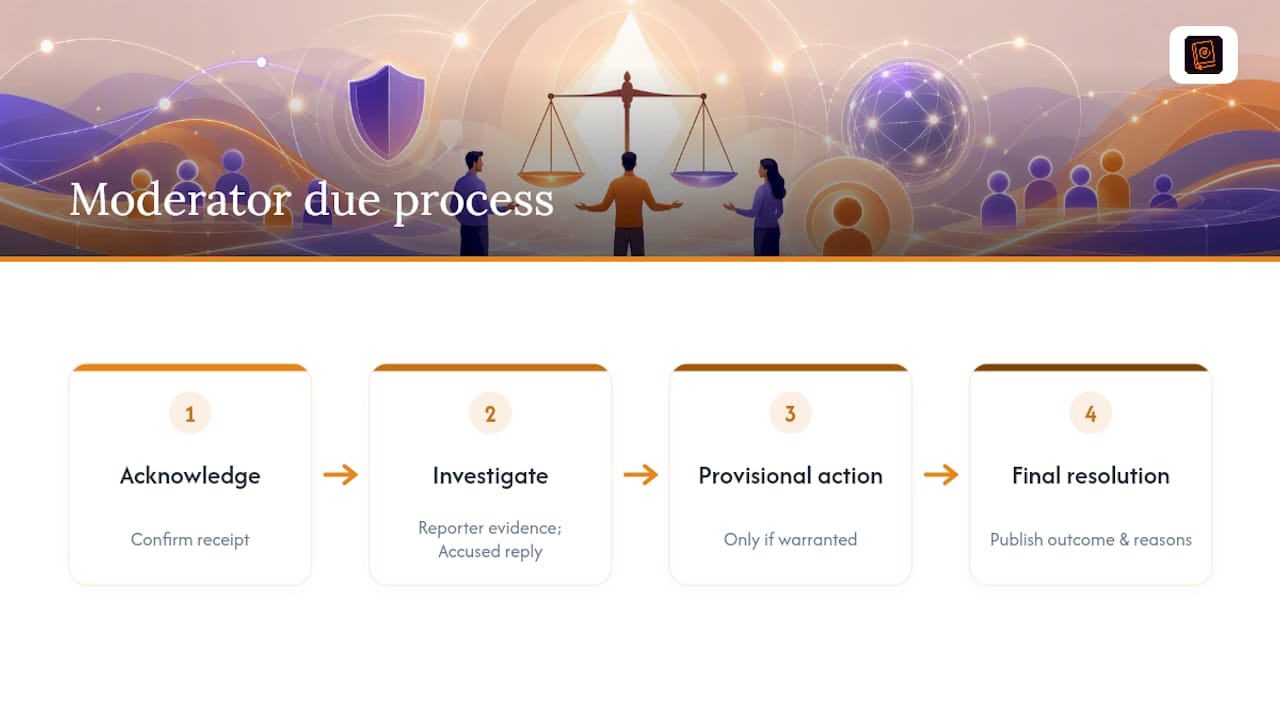
The strongest moderation teams treat evidence collection as a shared responsibility. A reporter provides match IDs and footage; the accused player gets a genuine chance to respond before any permanent action lands. That right to respond matters even when the evidence looks damning at first glance, because predictable public updates and a real chance to respond are what preserve moderator credibility and prevent rumor from filling the silence.
Transparency doesn't mean publishing every detail of an investigation. It means the community knows the process exists, roughly how long it takes, and what happens at each stage. A moderator team that announces "we're aware of this report and reviewing it" within a day builds more trust than one that stays silent for a week and then drops a ban with no explanation.
Consistency across cases matters just as much as speed. If one player gets a warning for a first offense and another gets an instant permanent ban for the same violation, the inconsistency itself becomes the story, regardless of whether either penalty was individually justified. Written guidelines for what triggers each level of sanction protect moderators from that appearance of favoritism as much as they protect players from arbitrary treatment.
Privacy and Data Protection on Public Leaderboards
Leaderboards expose more personal information than most players realize. A username, a match history, and a timestamp pattern can be enough to identify someone's schedule, location, or real identity when combined with other public data. Organizers who display leaderboards should think about what's actually necessary to show versus what's just convenient.
Session logs, IP addresses, and device identifiers used for anti-cheat verification carry real privacy weight. Players should know what data a platform collects to validate scores and how long that data is retained after a season ends. A leaderboard that requires video proof for high-ranking entries should also have a clear policy on who can access that footage and for how long it stays available.
Practical steps players can take: use a handle that doesn't tie back to your real name if the platform allows it, avoid streaming session details that reveal your location or routine, and check whether a leaderboard platform lets you opt out of public display while still competing for rank internally. Organizers, in turn, should collect only the verification data a dispute process actually needs, not everything a system is technically capable of logging. Minimal collection isn't just good practice. It's fewer records to protect and fewer records to leak if something goes wrong.
Handling Ties and Ranking Disputes Fairly
A tie should have a published resolution rule before it happens, not one invented in the moment someone complains. Common tiebreakers include earliest submission time, fewer total attempts, or a secondary metric like completion speed within the same score. Whatever the rule, publishing it in advance removes the appearance of a decision made to favor one player over another.
Ranking disputes that aren't about ties, where a player believes their placement is simply wrong, need the same evidence standard as any cheating report. That means match logs, not just a screenshot of the current standings. A player who believes they were undercounted should be able to point to the specific match or session where the discrepancy occurred, and a moderator should be able to check that specific record rather than re-auditing an entire history.
The fairest systems separate "this rule produced an outcome I dislike" from "this rule was applied incorrectly." The first isn't really a dispute. It's a disagreement with policy, and the right response is feedback for a future season, not an appeal. The second is a legitimate claim that deserves investigation. Teaching players to tell the difference before they file a complaint saves moderator time and reduces the number of disputes that go nowhere.
Communicating Leaderboard Updates Without Causing Confusion
Silent changes to scoring rules or rankings are one of the fastest ways to lose a community's trust. A rating adjustment, a season reset, or a change to what counts as an eligible run should be announced before it takes effect whenever possible, not discovered by players checking their rank and finding it different.
Good update communication follows a rhythm: announce the change, explain the reasoning in plain terms, give a timeline for when it takes effect, and follow up once it's live to confirm nothing broke. Skipping the "why" is a common mistake. Players tolerate rule changes far better when they understand the problem the change was meant to fix, even if they don't fully agree with the solution.
Season resets deserve extra notice. Players who invested weeks climbing a leaderboard want advance warning before that progress disappears, not a surprise the morning the new season starts. Archiving the previous season's final standings, rather than simply erasing them, gives players a sense of permanence even when active rankings reset to zero.
Behaving Well in Public Leaderboard Chats and Comments
Public leaderboard comments tend to attract two kinds of posts: genuine questions about scoring, and running commentary on other players' rankings. The first kind keeps a community functional. The second kind, when it turns personal, is what usually forces moderators to start deleting comments and issuing warnings.
A workable standard is simple: comment on the number, not the person behind it. Questioning whether a score looks unusual is fair. Accusing a specific named player of cheating in a public comment thread, before any report has been filed or reviewed, is not. That kind of public accusation can do real damage to someone's reputation even if the claim turns out to be false, and it puts pressure on moderators to react to public sentiment instead of evidence.
Screenshots of chat logs used as "proof" in public arguments create their own problems, since context is easy to strip out and hard to verify after the fact. The better move, every time, is routing suspicion through the actual report process covered earlier rather than litigating it in the comments section. A leaderboard's public chat works best as a space for celebration and genuine questions, not a courtroom.
Why Leaderboard Etiquette Shapes Community Health
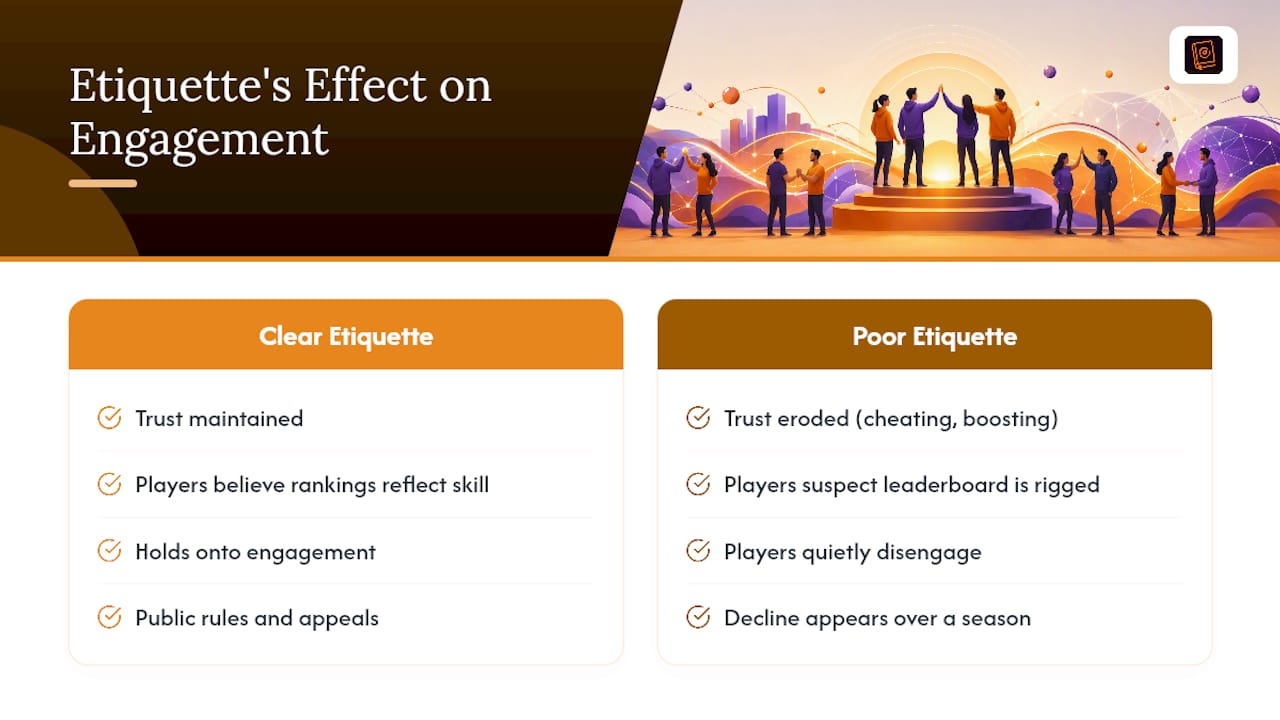
Communities with clear, enforced etiquette retain players longer than ones where the top of the board feels rigged or hostile. Cheating tools and boosting rings erode trust quickly, but communities that publicize clear, enforceable rules and a real appeals path tend to hold onto engagement that would otherwise drain away. Players who believe the ranking reflects real skill keep climbing it. Players who suspect it's rigged stop caring what number sits next to their name.
The damage from poor etiquette rarely shows up as a single dramatic incident. It shows up as a slow drift: fewer new players sticking around after their first public argument, veteran players quietly disengaging once a dispute gets handled badly, casual competitors deciding the leaderboard isn't worth the aggravation. None of that appears in a single day's metrics. It appears over a season, once engagement numbers are already down and the cause is hard to trace back.
Cheating itself is nothing new to competitive gaming, and it isn't going away. The long history of cheating across game types shows that modern anti-cheat has to combine technical validation with active community management, because no detection algorithm alone fixes a culture problem. Etiquette is the part of that equation players actually control. Rules and detection systems handle the technical side. How you treat the person you just passed on the board handles the rest.
A Note on Why This Matters
Fair leaderboards keep competitive gaming worth playing. Dubtrackr builds tools for players who want to track progress honestly, and that starts with treating verification as routine, not adversarial. If you're reading this before your next submission, adopt the habit now: document your runs, keep your public comments non-escalatory, and expect review as a normal part of ranked play, not an accusation.
— Daniel
Track Your Progress Without the Guesswork
Droidex Companion is a Windows companion app for Droid Tycoon players that tracks live stats using local screen recognition without manual logging mid-session.
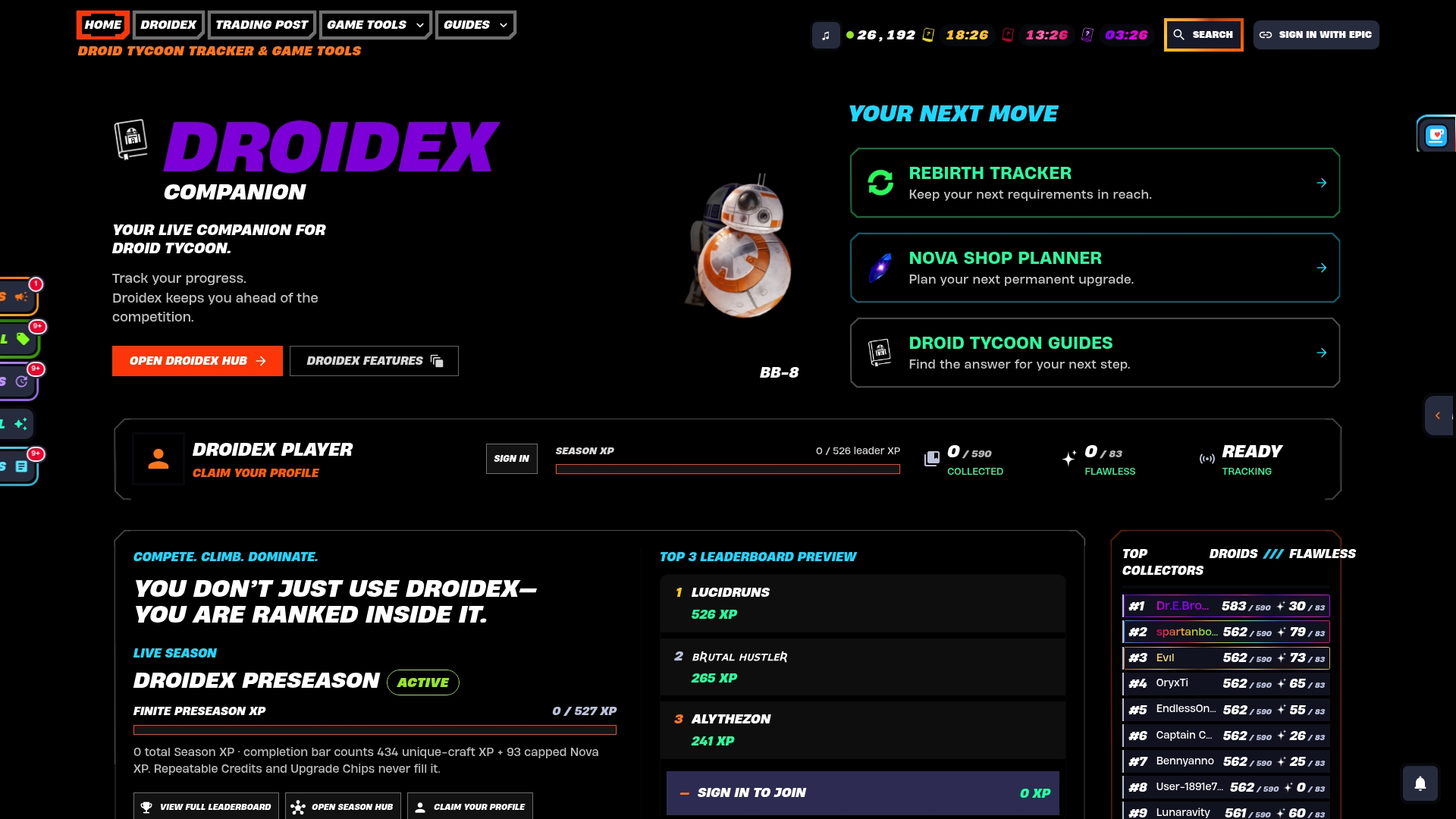
The feature set covers the parts of leaderboard etiquette that are hardest to do manually: live stat tracking that timestamps your progress automatically, customizable overlays that keep your session visible while you play, rebirth planning tools, and access to community statistics that let you compare your standing against other players transparently. When a moderator asks for verification, you have a real record instead of a reconstructed memory of what happened three matches ago.
Every core feature is free. Download Droidex Companion and start building a documented history of your runs before your next leaderboard submission, not after someone questions it.
Sources
- Challenger Mode — Leaderboards features (developers docs)
- Moderating Cheating Allegations with Due Process
FAQ
What Are the Different Ways to Display a Leaderboard?
Leaderboards typically display as global rankings, friend-only lists, category-specific boards (by mode, region, or time period), or seasonal boards that reset on a schedule. Organizers often combine several types on one platform, letting a player check their global rank and their friend-group rank separately. Droidex's community statistics tools show one version of category-based display built for Droid Tycoon players.
Can You Give an Example of a Leaderboard?
A typical example ranks players by total score, completion time, or resource count, updated automatically as new verified results come in. Racing games commonly show best lap times, while tycoon-style games often rank by total earnings or rebirth count. The format varies by game, but the core idea stays the same: a public, ordered list based on a defined metric.
Is It "Leaderboard" or "Leader Board"?
"Leaderboard" is the standard one-word spelling used across major gaming platforms and documentation. "Leader board" appears occasionally as a two-word variant, but it's far less common in modern usage. Stick with the single word for consistency with how most games and platforms refer to it.
What Are the Different Types of Leaderboards?
The main types include global boards, regional or server-specific boards, friend-only boards, and category boards split by game mode or metric. Some platforms also run seasonal leaderboards that archive and reset on a fixed schedule, keeping historical standings visible even after ranks return to zero.
What Should I Do if I Suspect Someone Manipulated a Score?
Collect match IDs, timestamps, and any available video before reporting anything. Submit through the platform's official report channel rather than a public comment, and expect an acknowledgment first, followed by an investigation before any action is taken.
Does Droidex Companion Cost Anything?
No published price applies. Droidex Companion's core features, including live tracking, overlays, and rebirth planning, are available without a mandatory payment, and current details are listed on Droidex's site.