
Collection value ranking in Droid Tycoon compares how much your droid roster is worth against other players. The roster is the set of droids and variants you own. Your position depends on what you hold, how far each droid is upgraded, and how the rank is measured. Droidex Companion reads your screen locally, so you can follow your collection value and plan upgrades without typing numbers in by hand.
One caution first. We could not find a published formula from the game's developers for how the in-game rank is computed or how often it refreshes. This guide therefore separates what is documented (droids, variants, upgrade costs) from what you should verify in your own client (exact weighting and refresh timing).
TL;DR
- Collection value is built from the droids you own and the variant of each one. A higher variant is worth more than the same droid at Base.
- Every droid except Iconic ones has five variants: Base, Gold, Diamond, Rainbow and Beskar.
- Upgrade Chip costs rise sharply at each step, so the cheapest value gain is usually a low-tier variant upgrade, not a late Beskar jump.
- Rebirth resets change what you can hold, so track value before and after each cycle.
- Droidex Companion tracks collection data locally and is free to download.
Table of Contents
- What collection value ranking measures
- How the roster is built: droids, rarity and variants
- What it costs to move a droid up a variant
- What affects your collection value
- How the rank updates
- Perspective: why we track locally
- Track your collection with Droidex Companion
- A practical routine for climbing the ranking
- Mistakes that cost rank
- FAQ
- Sources
What collection value ranking measures
Droid Tycoon is listed by Epic under Simulation & Tycoon, and its core loop is simple: droids generate credits per second, and those credits fund the next droid or upgrade. A collection ranking turns that roster into a comparable number.
Three separate ideas get mixed up under the label "ranking", so it helps to keep them apart:
- Collection value: the worth of what you own right now.
- Income rate: how many credits per second the roster produces.
- Leaderboard position: where your number sits against other players.
A roster can be high in value and modest in income, for example when you hold many expensive variants of droids that earn little. The reverse also happens. If a ranking is your goal, read the board's own label before you plan around it, because a board that sorts by income rewards different choices than a board that sorts by collection value.
How the roster is built: droids, rarity and variants
The droid list is the foundation. One community catalog counts 56 unique droids with five rarity tiers, and each droid except Iconic ones comes in five variants: Base, Gold, Diamond, Rainbow and Beskar. Income rises with each variant. Some droids appear to differ in type, such as Worker or Astromech, which affects the role they play in your base.
The same catalog shows how income scales on cheap droids. A common Worker such as Mouse earns 2 credits per second at Base, 4 at Gold, 8 at Diamond, 16 at Rainbow and 24 at Beskar. A Gonk doubles those figures at each step: 4, 8, 16, 32 and 48. The jump from Rainbow to Beskar is smaller than the earlier doublings, a pattern worth remembering when you decide where your Chips go.
For full per-droid detail, the Droidex droid catalog lists the roster with stats and variants. Individual pages cover droids such as R2-D2, R5 and R7.

What it costs to move a droid up a variant
The game was released on May 1, 2026, by FOAD and Blzn Studios with Epic Games and Lucasfilm, according to the Fortnite community wiki. The same page lists Upgrade Store prices in Chips. The figures below are the ones shown for the Common, Rare, Epic and Legendary tiers at the time of writing.
| Step | Common | Rare | Epic | Legendary |
|---|---|---|---|---|
| Base to Gold | 5 | 30 | 120 | 400 |
| Gold to Diamond | 25 | 60 | 180 | 1.2K |
| Diamond to Rainbow | 40 | 100 | 240 | 4K |
| Rainbow to Beskar | 80 | 250 | 5K | 12K |
Two patterns stand out. First, the Epic tier is cheap until the last step, where Rainbow to Beskar costs 5K Chips against 240 for the step before it. Second, Legendary costs escalate at every step. Patches can change these values, so check the current Droid Tycoon tools page for base income, Nova and Chip costs after each update.
Value per Chip, a simple way to compare
To choose between two upgrades, divide the gain by the cost. Take a Common Worker like Mouse. Moving from Base to Gold adds 2 credits per second for 5 Chips, or 0.4 credits per second per Chip. Moving from Rainbow to Beskar adds 8 credits per second for 80 Chips, or 0.1. The earlier step is four times as efficient.

The same logic applies to collection value if the board weights variants by tier. Cheap early steps across many droids usually lift a roster faster than one expensive finish on a single droid. Test this on your own account: note your rank, make a batch of low-cost upgrades, and see whether the position moves.
What affects your collection value
Several mechanics feed into the number. Not all of them are documented by the developers, so treat the list below as the factors a player can observe and verify.
- Owned droids. More distinct droids widen the roster.
- Variant level. Higher variants raise both income and, on most trackers, the worth of the entry.
- Rarity. Legendary and rarer droids carry more weight than Common ones.
- Rebirth progress. A rebirth resets part of your progress in exchange for permanent advantages, so your roster and your rank can drop before they rise.
- Update changes. New droids, rebalanced income and altered costs shift the baseline. The 1.34.0 update added WG-22, Power Droids and Rebirth Path 6, and the v1.24 patch notes show an earlier round of changes.
The interaction between rebirth and rank is where most players lose positions. A reset is a planned trade, so decide the timing from numbers rather than from impatience. The rebirth cycle tracker lists requirements for each cycle so you can see what you must hold before you reset.
How the rank updates
We found no official statement of how often the board refreshes or which tie-break rules apply. Do not assume a live update. The practical test is a controlled one:
- Record your displayed rank and collection value.
- Make one clearly measurable change, such as a single variant upgrade.
- Check the board after a few minutes, then again after you return to the lobby.
- Write down the delay, if any.
Repeat it once after a restart. If the rank only changes after a session ends, plan your comparisons per session and not per upgrade. This also protects you from judging a strategy on stale data.
Perspective: why we track locally
We built Droidex Companion around one belief: a ranking is only useful when you can see what caused it. The in-game board gives a position. It does not tell you which upgrade moved it, what a reset will cost you, or which droid is the weakest link in your roster.
That is why the app reads the screen on your own Windows PC with local screen recognition. It captures the values the game already shows you, stores them as a history, and lets you compare snapshots. Nothing depends on a manual spreadsheet that goes out of date the moment you buy a droid.
Our advice for ranking is plain. Track the collection before every rebirth, upgrade the cheapest steps first across the whole roster, and record what each change does to your position. A single data point proves nothing, but ten of them show a pattern. If you want to compare against other players, the app's leaderboard system gives you a shared reference, and the community stats page shows how other players' accounts are distributed.
— Daniel
Track your collection with Droidex Companion
Droidex Companion is a Windows app for Droid Tycoon players. It shows live stats, supports rebirth planning, manages your collection, offers customizable overlays and includes calculators and update guides. It is free to download, and all features work without payment. Support through Ko-fi is optional.
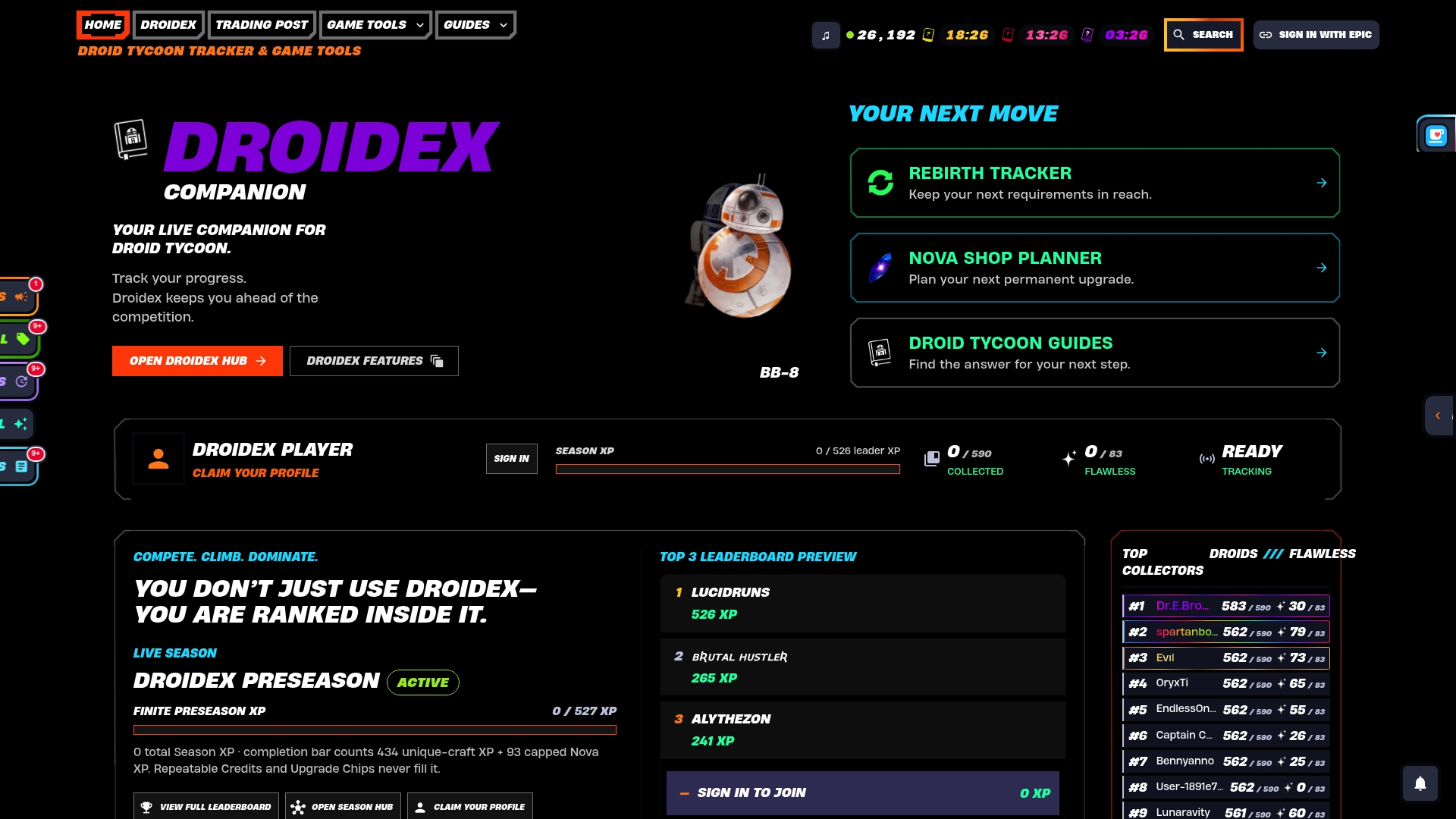
If you want to start with the data and no install, open the Droidex Companion page to see the features and download the app. The 1.2.9 release notes list what the current version changed.
A practical routine for climbing the ranking
A steady routine beats occasional bursts of spending. This one fits a normal play session.
Before the session
Open the overlay and note your collection value, income per second and Chip balance. Compare them with the last saved snapshot so you know what changed overnight, if anything.
During the session
Spend Chips on the lowest cost-per-gain upgrade available. Using the table above, a Common or Rare Base to Gold upgrade nearly always beats a Legendary Rainbow to Beskar step in efficiency. Keep a reserve if a rebirth requirement is near, since spending below the threshold can delay the reset.
After the session
Save the final numbers and look at the change. If rank moved less than expected, check whether the board has refreshed before you change your strategy.
Mistakes that cost rank
- Chasing one Beskar. The final variant step is the least efficient on most tiers in the table, so one finish can cost as much as dozens of early upgrades.
- Resetting without a snapshot. Without a before and after record, you cannot tell whether the reset paid off.
- Ignoring patches. Cost and income values change, so a plan built on last month's numbers can be wrong.
- Comparing different boards. Income and collection value are different measures, so a rival ahead on one may trail on the other.
- Trusting one reading. A rank captured mid-refresh can mislead, so confirm it twice.
FAQ
Is collection value the same as income per second?
No. Income per second measures how fast your droids earn credits, while collection value measures the worth of the roster you hold. The two usually rise together, but a roster of costly variants on low-income droids can score high on one and low on the other.
Which upgrades raise my ranking fastest?
The cheapest steps across many droids usually give the most gain per Chip. For example, a Common Base to Gold upgrade costs 5 Chips, and a Legendary Rainbow to Beskar upgrade costs 12K. Verify the effect on your own board, because the exact weighting is not published.
Does a rebirth lower my collection value?
It can, because a rebirth resets part of your progress in exchange for lasting advantages. Record your values before the reset and compare them afterward. The rebirth cycle tracker lists the requirements for each path.
Do I have to pay to use Droidex Companion?
No. The app is a free download and every feature works without payment. A donation through Ko-fi is optional and supports development.
Sources
- Fortnite official site
- All Droids in Fortnite Star Wars Droid Tycoon
- Droid Tycoon on the Fortnite community wiki